
Kala cotton is indigenous to this region and grows on rain rather than irrigation. The fibre is shorter and coarser than upland cotton, which makes it harder to spin and easier to break on the loom. The cloth that comes out of it is heavy, absorbent and gets softer with washing.
The loom is a pit loom: the weaver sits at floor level with one leg in a recess, which gives the tension control that a short-staple yarn needs. Warping a throw-cover length is a day of layout before a single pick is thrown, and the whole piece is one continuous warp.
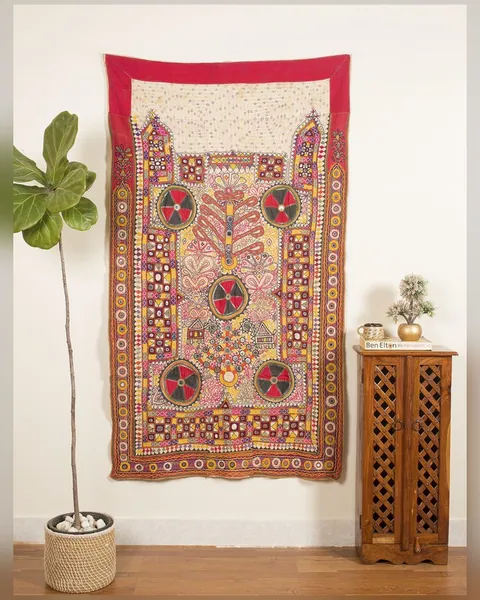
The embroidery is a separate craft and usually a separate household. The mirror work, the cowrie lines and the running-stitch fills seen on these pieces are worked after the cloth leaves the loom, in the styles associated with the Ahir, Rabari and Suthar communities of Kutch.
That separation matters commercially. An embroidered panel is not one artisan, it is two or three, and the lead time is the sum of their calendars. A buyer who treats the embroidery as decoration and compresses it will get a machine-stitched copy instead.
The records we carry from this belt include the Kala cotton pillow row in the export specimens and the Kutch wall hanging and patchwork pieces photographed at the fair. Face fabric, weave density and trim are stated where the sheet states them, and the rest is confirmed with the cluster.
The pit loom has a second consequence worth naming. Because the weaver sits below the floor line, the warp is tensioned by body weight rather than by a metal mechanism, which is why a handloom length varies slightly across its own width. That variation is the reason a handloom cushion cover is cut and sewn to order rather than stacked off a shelf.
A handloom product is three jobs. Buyers usually price only the third.