India
Craft Trade

The belt atlas

Four belts.
Named, not assumed.

India's craft output follows its geology and its season: river clay, desert cotton, high-altitude pasture wool. Each belt below names the crafts worked there and states plainly what documentation we hold.

Cluster, society, materials, port and lead time are the trade desk's own records.

Vintage Kutch wall hanging, hand-appliqued cotton with mirror work.

01

Kutch and Marwar Desert Corridor

Gujarat and Western Rajasthan

The corridor around Bhuj and Ajrakhpur works resist-dyed cotton, castor-oil rogan and hand embroidery. We hold supplier documents for printed cotton goods from Jaipur rather than from this belt, so the pieces shown here are photographed stock.

Crafts worked
Natural indigo Ajrakh, castor oil Rogan art, Kutch embroidery and mirror work, hand-woven durries.
What we hold
One photographed Kutch wall hanging from a supplier deck, and the embroidered panels we shot at the October craft fair. No supplier document, GI entry, port, lead time or test claim for this belt is on file.
Lost-wax cast brass candelabra in dark patinated bell metal.

02

Bastar Forest and Mineral Belt

Chhattisgarh

Bastar casters work the lost-wax method: a wax coil over a clay core, invested, fired out, and replaced with metal in a mould that is broken to release the piece.

Crafts worked
Dhokra lost-wax bell metal, wrought iron, terracotta architectural tiles.
What we hold
One cast candelabra photographed in a workshop setting, carried over from version 1. It is a reference to the craft, not a batch we can quote: no document, GI entry, alloy certificate or lead time is on file.
Belt record 03

No photograph
on file.

The archive holds no belt photograph for this corridor. The record is published without one rather than with a borrowed image.

03

Kashmir High-Altitude Valleys

Jammu and Kashmir

The valley works fine hand-spun fibre and counted needlework, and its woodcarvers work seasoned walnut. Both are slow, hand-density trades, which is why they are quoted per piece rather than per metre.

Crafts worked
Hand-spun fine wool, Sozni needlework on shawls, carved walnut screens.
What we hold
Nothing. We hold no photograph and no document from this belt, which is why the panel carries no image and the two wool references on the site are labelled to confirm.
Turned wooden rods and small inlaid ornaments from a craft stall.

04

Thanjavur and Channapatna Corridor

Tamil Nadu and Karnataka

Channapatna turners shape soft timber on a hand lathe and bond colour to it with lac burnt on by friction. Near Thanjavur, bronze is still cast in the five-metal tradition.

Crafts worked
Channapatna lac-turning, Swamimalai bronze casting, temple painting and relief work.
What we hold
Turned and inlaid woodwork photographed at the October craft fair, shown as technique reference. No supplier document, GI entry, guild count or toy-safety claim is on file for this belt.
Register

What we can put our name to.

Version 1 of this site published six GI registry rows with society names, artisan counts, lab standards and batch sizes. No document behind those rows is on file today, so they are withdrawn and this register states what we actually hold.

Crafts Namakh describes, and the documentation held for each
CraftRegionWhat we hold
Naturally dyed hand-block cottonKutch, GujaratPrinted cloth and durries photographed at the October craft fair; no sheet
Lost-wax bell metal castingKondagaon, ChhattisgarhOne cast candelabra carried from version 1; no sheet
Hand-spun fine wool and needleworkSrinagar, Jammu and KashmirNothing yet: no photograph and no sheet from this belt
Lac-turned woodworkRamanagara, KarnatakaTurned rods and inlaid ornaments from the craft fair; no sheet
Five-metal bronze castingThanjavur, Tamil NaduNothing yet: named as a craft, with no stock behind it
Hand-formed stone and clay wareUkhrul, ManipurDark hand-formed vessels from the craft fair; no sheet, no test report
Marks

What the belts draw when they are not making a product.

Painted languages that sit beside the traded crafts. Shown as motif and as footage, not as a reference you can order.

Field film, 9 seconds

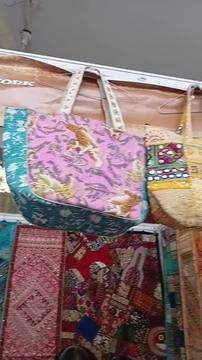
Shot on a phone at the craft fair in October 2026: Kutch applique bags and embroidered panels on a stall rail, then lifted one at a time to show the reverse. Muted, looping, and the only footage we hold from the visit.

Warli, and the ring of hands

Warli is rice paste on an earth wall. A border of dots first, then the figures: a circle for a head, two triangles for a body, lines for arms. Two figures holding hands become a ring, and the ring is a dance, not a pattern. It is painted for a wedding and washed off when the wall is replastered.

Gond painting starts the other way round. The outline is drawn, then filled with short lines and dots, and the fill is what identifies the hand. Both appear in the stock we photographed at the fair, on cloth panels and cushion covers.

Neither form is a published Namakh reference. If you want either, we source it as a new line and the artist and village get named on the sheet before it is quoted.

Choose a belt.
We will open the book.

Tell us the corridor and the piece. We will tell you what is documented, what is not, and how a sample would be made.

Write to the trade desk